Obsidian is the record of a fast decision. Lava that cooled too quickly for atoms to organize themselves into crystals, frozen instead into glass with a surface that reflects like water at night. We look for pieces with real optical depth, clean fracture, and in the sheen varieties, the particular angle at which the color suddenly appears.
What Obsidian Is
Obsidian is a natural volcanic glass rather than a mineral, which means it has no ordered internal crystal structure and no fixed chemical formula. It forms when high-silica, rhyolitic lava cools so rapidly that crystals never get a chance to nucleate. Hardness is around 5 to 5.5, and it breaks with a conchoidal fracture, producing edges that can be extraordinarily sharp, a property people have relied on for tools and blades for tens of thousands of years. Varieties come from what happens inside the glass: snowflake obsidian carries pale spherulites of cristobalite, mahogany obsidian its red-brown iron oxide banding, and rainbow and sheen obsidian their color from aligned nanoscale inclusions. Geologically speaking obsidian is young, since glass slowly devitrifies over time. Notable sources include Oregon, California, Mexico, Iceland, and Armenia.
Obsidian Meaning and Metaphysical Properties
Obsidian is traditionally associated with the root chakra and is one of the most widely used protective stones in modern practice. It is often described as a mirror rather than a shield, something that reflects back what is actually there instead of softening it.
Because of that reflective quality it is traditionally linked to shadow work, to honesty with oneself, and to cutting through self-deception. Many people work with it in periods of transition or reckoning, and it has a long history in scrying, where polished obsidian mirrors were used as a surface for contemplation.
How to Use Obsidian
- Keep a piece near an entryway or on a windowsill as part of a protective arrangement for the home.
- Use a polished sphere or mirror as a focus for contemplative gazing rather than active visualization.
- Place obsidian at the perimeter of a grid where the intention involves boundaries or clearing.
- Pair it with black tourmaline or hematite for grounding, and handle natural flaked edges carefully, since they can cut.
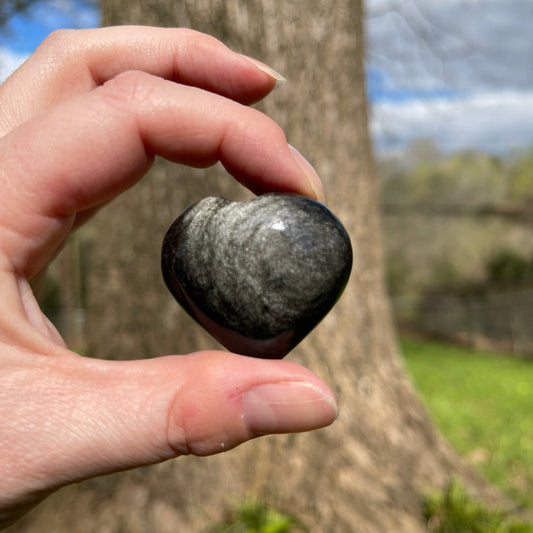
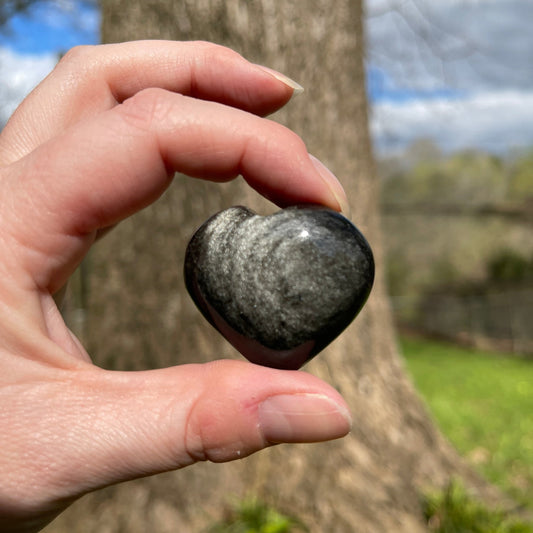
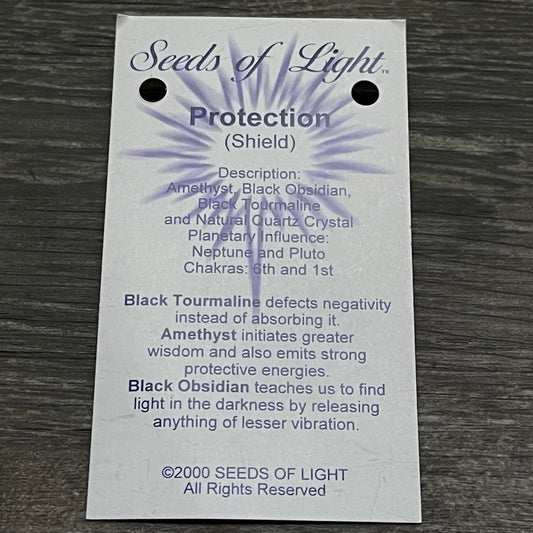
Healing Stone Beings brings together hand-selected obsidian across its varieties: snowflake, mahogany, rainbow, sheen, and classic black, in spheres, points, palm stones, and raw pieces. Every one was picked in person for depth and finish. Browse at your own pace and see which one holds your gaze.
 Sold out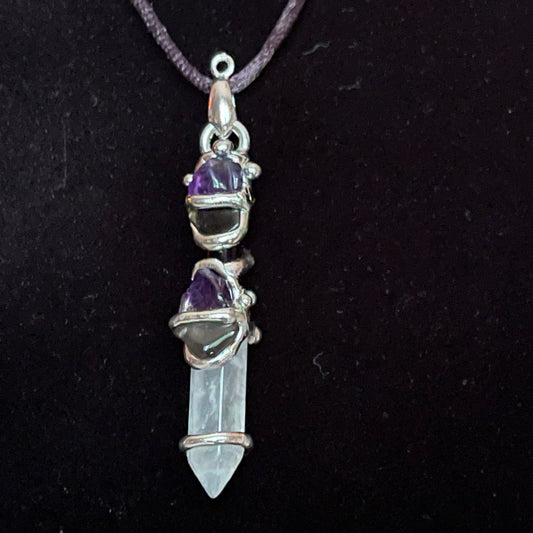
 Sold out
 Sold out